
A Sales Meeting Is the Last Domino: How B2B Outreach Actually Works

Jordan Ellis
Revenue Research Analyst
February 14, 2025
·8 min read
Imagine two outreach teams.
Team A sends 20,000 emails in a month. It gets 1,100 opens, 140 replies, and 28 meetings.
Team B sends 2,000 emails. It gets 430 opens, 95 replies, and 31 meetings.
Which team is better? The first team did ten times more work at the top of the funnel. It also created fewer meetings.
Now add one more detail. Team A’s 28 meetings produce one real opportunity. Team B’s 31 meetings produce eleven.
The usual outreach dashboard makes Team A look busy. A business owner would probably prefer Team B.
This is where beginners often get confused. Outreach looks like a sending process because sending is the easiest part to count. But the send is not the system. It is one domino in the middle of the system.
The factory model looks neat and fails quietly
A lot of outreach is organised like a factory:
- Buy a list.
- Clean the emails.
- Write a template.
- Load a sequence.
- Send at scale.
- Count replies.
The process is easy to manage because every step produces a visible output. The problem is that a factory is good at repeating something. It does not tell us whether the thing being repeated makes sense.
If the account selection is wrong, scale multiplies the mistake. If the problem hypothesis is weak, automation repeats a weak idea faster. If the person is wrong, adding more follow-ups does not make the person more relevant. The neatness of the process can hide the weakness of the thinking.
The meeting is the last domino
A sales meeting feels like the main result because it appears on the calendar. But several earlier things had to go right. The company had to be plausible. The problem had to matter. The person had to be close enough to the problem. The timing had to make sense. The message had to be clear. The reply had to move the conversation forward.
The meeting is simply the visible result of all those earlier judgments. This is why meeting-booked rates can be misleading. A meeting can be booked for the wrong reason, with the wrong person, at the wrong company. A calendar event is not proof that outreach worked. Sometimes it is only proof that someone was curious or polite.
Start with a problem, not a database
The common workflow begins with a list of companies. A stronger workflow begins with a problem. For example:
Companies that have just hired a large number of sales representatives often struggle to give those reps enough account context.
Now the rest of the process becomes easier to reason about. Which companies are hiring quickly? Which sales roles are affected? Who owns account selection or sales operations? What signs would make the problem more likely? What question could test the idea?
The process is no longer “find 5,000 VP Sales contacts.” It becomes “find companies where this specific operating problem is plausible.” That is a much smaller and more useful universe.
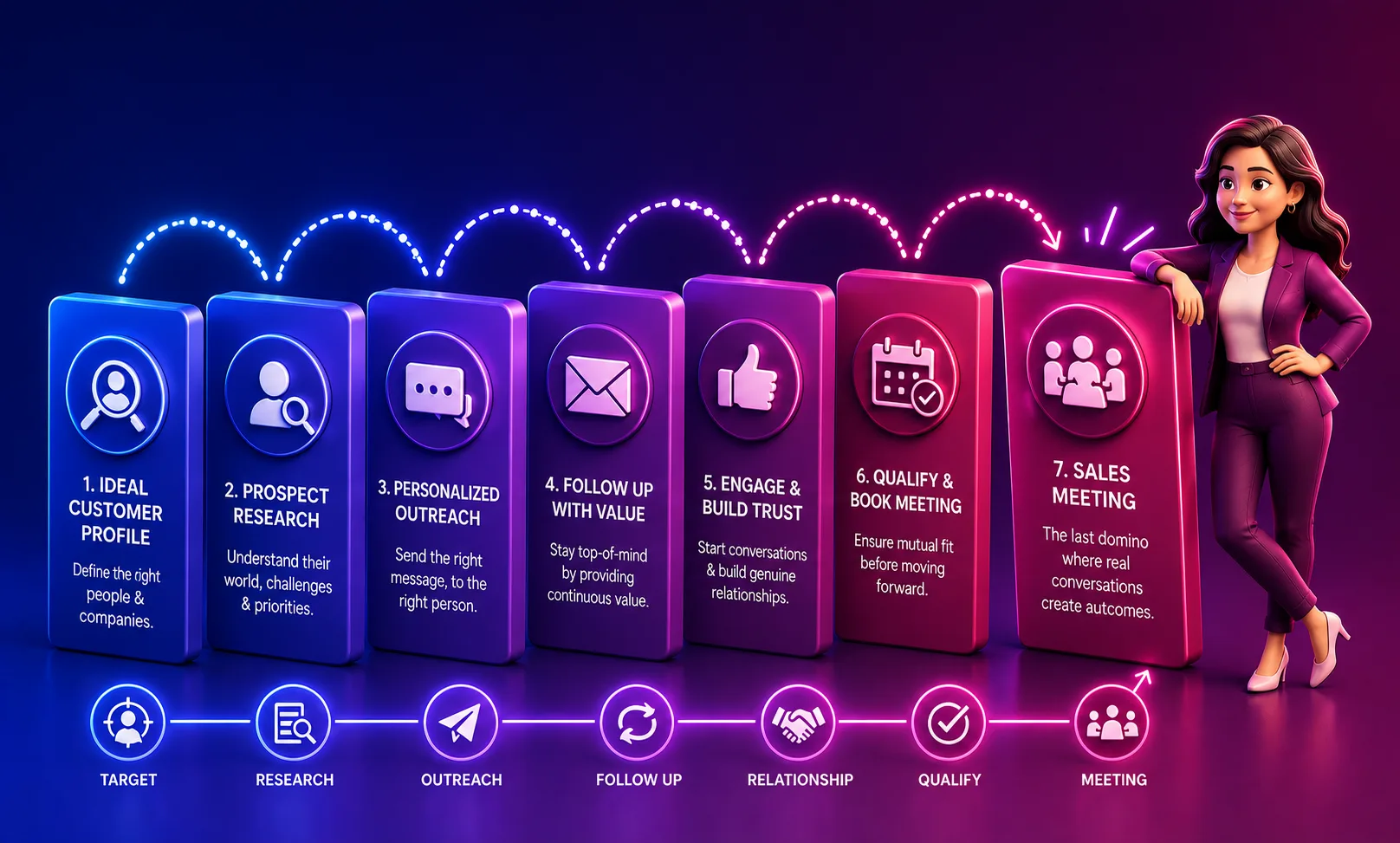
The seven-stage outreach loop
Outreach works better as a learning loop than as a one-way funnel.
1. Choose one problem to investigate
Not every problem the product solves. One problem. A company selling a broad sales platform may solve lead research, account prioritisation, messaging, follow-ups, and reporting. Trying to mention all of that at once creates mush. A cleaner starting point is one situation: newly hired reps are spending too much time deciding whom to contact.
2. Find companies where the situation is plausible
A company that hired one salesperson last year is not the same as a company that added twenty this quarter. The second company gives the hypothesis some weight.
3. Find the nearest credible owner
The biggest title is not automatically the best contact. A sales operations leader may know the workflow better than the CEO. A frontline manager may feel the problem more sharply than the CRO. The first contact is often the person closest to the issue who can understand it and move it internally.
4. Create a reason for now
The message needs a timing anchor. A new market launch, a hiring push, a tool migration, a leadership change, or a public complaint can create that anchor. Without one, the message often sounds like it could have been sent any day in the last three years.
5. Send a diagnostic opening
The first message tests the idea. It does not dump the entire product story. A diagnostic opening sounds like this:
I noticed the team added twelve AEs across two regions. Has account allocation become more centralised, or are reps still choosing targets independently?
The question tells the buyer what the sender thinks may be happening.
6. Classify the response
Not every reply means the same thing. “Send details” may be polite dismissal. “Talk to Priya” is a routing response. “We already solved this” is useful market information. “Yes, this is a mess” is a strong problem confirmation. A reply is not just positive or negative. It contains information about the account, timing, person, and problem.
7. Feed the result back into the system
This is the step many teams skip. If several companies say the problem is owned by RevOps rather than Sales, the contact strategy changes. If the problem appears only after a certain hiring threshold, the ICP changes. If one signal creates far more useful conversations than another, the targeting changes. Outreach then becomes smarter over time instead of merely larger.
A message can succeed while the outreach fails
Suppose a clever email gets a reply from a CFO. The CFO agrees to a meeting because the opening was interesting. During the call, it becomes clear that the product is used by frontline sales teams, the CFO does not own the process, and the company has no current need.
Was the email successful? At the message level, yes. It got a reply and a meeting. At the outreach level, no. The system selected the wrong person and probably the wrong account.
This distinction matters because teams often optimise the visible stage. They rewrite subject lines to increase opens. They use stronger calls to action to increase bookings. They celebrate reply rates. But if the replies do not become meaningful conversations, the optimisation is happening in the wrong place.
Outreach is a process of increasing certainty
At the beginning, the sender knows very little. The company may have the problem. The person may own it. The timing may be relevant. The first message reduces some uncertainty. The reply reduces more. A short exchange clarifies whether the problem is real, how serious it is, and who else is involved. The meeting comes after enough uncertainty has been removed.
This is a better model than “persuade a stranger to book a call.” The goal is not to create certainty with bold claims. It is to build certainty through a sequence of small confirmations.
Automation belongs after the thinking
Automation is useful when a repeatable pattern has already been found. For example: a specific company change often creates a specific problem, a particular role usually owns it, one opening question consistently produces useful replies, and one kind of follow-up adds meaningful evidence. At that point, automation saves time.
Before that point, automation can make weak assumptions look like a system. The tool runs smoothly. The dashboard fills up. The market learns to ignore the sender.
A simple reverse-engineering test
Take any meeting that came from outreach and work backwards. Why did the buyer accept? Why did the person reply? Why did the message feel relevant? Why was that person chosen? Why was that company chosen? What problem was being investigated?
If those answers are clear, there is probably a real process underneath the meeting. If the answer is “we sent enough messages and someone happened to reply,” there is activity, but not much of a system.
A sales meeting is the last domino. The useful work happens before it falls.

Jordan Ellis
Revenue Research Analyst
Studies pipeline data and buyer signals to separate real intent from noise.